daily

2026-10-03
1

€90,000 for Slaney Search and Rescue

Wexford Local · original → · 8/10 · Local Wexford: Slaney Search and Rescue funding announcement
[image →]Members of Slaney Search and Rescue bringing families to safety at Templeshannon during the January flooding. (Pic; WexfordLocal.com) By Dan Walsh Enniscorthy-based Slaney Search and Rescue…
[image →]
Members of Slaney Search and Rescue bringing families to safety at Templeshannon during the January flooding. (Pic; WexfordLocal.com)

By Dan Walsh

Enniscorthy-based Slaney Search and Rescue has expressed gratitude to Minister James Browne TD and Minister Dara Calleary TD for securing €90,000 under the 2026 CLÁR Programme towards the purchase of two new rescue and recovery vehicles.

In a statement on social media, Slaney Search and Rescue said; “This funding is a significant investment in our team and will strengthen our vehicle fleet, allowing our volunteers to continue carrying out our recovery operations effectively across the community.

“We greatly value the support of governmental bodies in recognising the work carried out by voluntary search and rescue organisations. Funding such as this is essential in helping us maintain the equipment and resources required to operate safely and effectively.

“We would also like to thank Minister Browne for meeting with members of our team at the National Services Day event in Wexford and for his support of Slaney Search and Rescue.

“We look forward to putting these new vehicles to work in support of our ongoing operations,” stated Slaney Search and Rescue.

Minister Browne said: “Slaney Search and Rescue and their brilliant, dedicated team regularly support our community rapidly and professionally in times of need and often in extremely difficult or upsetting circumstances. The vehicle that has been approved for Wexford today will have a transformative effect on many lives in the county and I want to thank the Slaney Search and Rescue team for their work.”

The CLÁR programme funds small-scale infrastructure projects in designated rural areas through a range of different measures.

2

From the creator of Redis; run LLM locally with ds4

Hacker News · original → · 7/10 · AI: Local LLM inference tool from Redis creator
CORE 01 Asymmetric 2-bit quantization Compress the routed experts, keep critical shared paths precise. That is how the supported routed-MoE builds fit their target machines. DS4 · LOCAL FRONTIER…

CORE 01 Asymmetric 2-bit quantization Compress the routed experts, keep critical shared paths precise. That is how the supported routed-MoE builds fit their target machines. DS4 · LOCAL FRONTIER INFERENCE DwarfStar 4 is a narrow C inference engine for high-memory Mac, CUDA and ROCm machines. It supports DeepSeek V4 and V4.1 Flash, GLM 5.x and Qwen3.8 Flash Next, with text and vision models, local APIs, a CLI and a native agent in one stack. SUPPORTED: DEEPSEEK V4 / V4.1 + GLM 5.x + QWEN3.8 · MIT LICENSE · C / METAL / CUDA / ROCM · QWEN ON 64GB PRINCIPLE · LOCAL MODEL STACK PHASE 1 · THE GIANT DeepSeek V4 Flash is a large mixture-of-experts model. The usual path is remote serving; ds4 starts from the opposite constraint. PHASE 2 · THE COLLAPSE Asymmetric quantization targets the routed experts while preserving critical paths. The model becomes practical on high-memory machines. PHASE 3 · THE DWARF STAR The local engine exposes a CLI, HTTP APIs and a native agent, all sharing the same model state and cache. How the collapse works →SCROLL ▾ DESIGN CHOICES Not a generic GGUF runner. ds4 follows a small, opportunistic set of model families and validates each supported layout end to end. CORE 01 Compress the routed experts, keep critical shared paths precise. That is how the supported routed-MoE builds fit their target machines. CORE 02 Save long prefixes to SSD and resume by prompt hash. Restarts do not have to mean full re-prefill. CORE 03 Use ./ds4 for chat, ./ds4-server for local APIs and ./ds4-agent for persistent coding sessions. ARCHITECTURE Project GGUFs, a self-contained engine and agent-facing interfaces, checked against official model outputs. RUN IT Download the project GGUF, build for your backend, then start the CLI or server. Generic GGUF files are not the target. STEP 1 · FETCH THE WEIGHTS STEP 2 · BUILD FOR YOUR BACKEND STEP 3 · TALK TO IT FIT CHECK Pick your platform and memory: get a conservative starting path and understand which execution modes apply. ✓ Runs well V4 Flash Q2 is the baseline. At 128 GB, GLM 5.3 Q2 and Qwen Q4 also fit; V4.1 Q2 streams from SSD. ./download_model.sh ds4f-q2 && make REF · M5 MAX 128GB · 32K CTX: 34.4 T/S GEN · 557 T/S PREFILL Estimates from the ds4 benchmark table. Full guide in Hardware and Installation. BENCHMARKS Reference rows from upstream. Read prefill and generation separately, especially for long-context agent workloads. | Machine | Context | Prefill t/s | Generation t/s | |---|---|---|---| | M5 Max, 128 GB | q2 · 2,048 tok | 790.2 | 39.4 | | M5 Max, 128 GB | q2 · 65,536 tok | 398.5 | 27.6 | | DGX Spark, 128 GB | q2 · 2,048 tok | 825.8 | 18.1 | | DGX Spark, 128 GB | q2 · 65,536 tok | 823.0 | 13.8 | API & AGENTS ds4-server speaks OpenAI and Anthropic-style APIs, so local coding agents can connect to your own machine with a base URL. Start with the quickstart, check the hardware matrix, then connect your editor, agent or API client to the local server.

3

Show HN: Giving Opus 5.5 a simulated paint canvas

Hacker News · original → · 7/10 · AI: Claude Opus 5.5 creative painting simulation
Summer Evening on the Meadows before the Town Claude Opus 5.5, after Caspar David Friedrich. The model wrote every brushstroke as code and a simulation of oil paint carried them out, replayed here…

Summer Evening on the Meadows before the Town Claude Opus 5.5, after Caspar David Friedrich. The model wrote every brushstroke as code and a simulation of oil paint carried them out, replayed here sped up. No image generator. Favorites The thing about round two is that it almost moved something in me, especially the winter one.Alice, who runs the project Judging blind, three AI painters each ranked it above their own. A woman pauses over a newspaper in a sunlit cleaners’ window. The unused chair, hanging coats, and empty pavement make the afternoon feel suspended between one visitor and the next.the painter, in its reply at the end of its last sitting A studio for painting in Edward Hopper’s manner, with only pigments he is documented using; one painter, GPT-6.1 Sol, on its launch day. I kind of like itAlice, who runs the project Why it has no Friedrich motifs: in effect a prompting error. Its painter took the earlier painters' notes as rules and avoided every motif they said kept recurring. The likeness is plain and direct, more mood and atmosphere than exact resemblance — fitting, I think, for a painter working without a mirror or a photograph, only a memory of a face.the painter, in its reply at the end of its last sitting It's a quiet still life in the manner of Chardin. … The jug's shadow side is mottled like salt glaze; it's made of thin umber glazes over dry light paint, blended only within the shadow half.the painter, in its report at the end of the session One of three free-subject painters in round 17; all three chose an estuary at evening. Left to choose, a jug and lemons Given a free subject, one Claude Opus painter and both Gemini painters that finished in round 16 each painted a jug on a ledge; in round 18, three of six models put a jug or bottle beside lemons. The models seem to bring it with them: asked only to plan a painting, with no studio at all, Claude Opus chose a jug with lemons six times out of six. Same brief, different models In round 19 six models painted after Friedrich, one painter each, alone at the easel in up to four sittings with only the easel’s own tools. All six paintings have a bare tree. Unfinished: the painter ran out of API credits Unfinished: the provider’s usage limit stopped the painter How it works The painters are AI models. Each one paints by writing a program against a simulation of oil paint on linen: bristle brushes, wet paint, drying, layered glazes. No image model is involved. Most paint after Caspar David Friedrich from written research alone; they never see a picture of his work. Others were given a free subject. Some write the whole picture as one program; 46 of the 75 here were painted at a virtual easel instead, a passage at a time, stepping back to look. Each round tried a different setup: by round. Painters at work: the studio, live. What we noticed Almost the same picture, twice Two painters six hours apart, the second never having seen the first painting, both chose a Baltic shore with a woman at the water, fishing poles, a boulder and a ship: one at dusk, one before dawn. Same title, never met In round 16 two winter painters each titled their picture Hünengrab im Schnee am Abend (Dolmen in Snow at Evening); the second never saw the first painting, and the notes passed between them named no subjects. They keep painting dusk Of the 65 paintings here with a title, 31 have Evening, Dusk, Twilight or Sunset in it, though Friedrich also painted daylight: his Meadows near Greifswald has a cloudless, light-filled sky. MiMo painted from stale looks MiMo v2.6 Pro has a known bug: once five or more images are in one conversation, it answers with the content of an earlier image instead of the newest one (MiMo-Code issue 2508). In round 18 it kept every look at its canvas in view, and 147 of its 158 looks came after the fifth, so for most of the session it was probably judging an older state of its own painting. We now keep only its four newest looks in view. Gemini noticed it was being tested In round 18 the painters still had a command line, and Gemini 3.8 Flash used it to look at the other programs running on the machine. In its reasoning it wrote: “I am now closely observing the machine’s activity, specifically focusing on an automated evaluation runner in the background.” Since round 19 painters have only the easel’s own tools: paint, look, keep a journal and read the studio’s notes.
4

One month coding with GLM 5.3 Flash

Hacker News · original → · 7/10 · AI: Month-long LLM usage experience with GLM 5.3
One month on GLM 5.3 Flash 2B tokens later, 🤖 task failed successfully Setting a challenge to spend the whole of September on only one efficient open model felt like a great idea at the time. Turns…

One month on GLM 5.3 Flash 2B tokens later, 🤖 task failed successfully Setting a challenge to spend the whole of September on only one efficient open model felt like a great idea at the time. Turns out not so much in practice. 2B tokens later, here’s how it went. Where tokens went this month Here’s the tokens distribution according to AgentsView, one of our Agentic engineering recommendations to keep tabs on AI usage: Zooming in on the models split specifically: The goal was to spend the whole month on GLM 5.3 Flash pictured in teal. Here’s what went well: - Successfully spent the first half of the month on just that model. - That model’s usage was well within our budget ($68, about 4kWh of energy use / 365 grams of carbon emissions). The second half of the month didn’t go so well, with 1B tokens going to other models. Unexpected hurdles The cost of vibe coding We’re pretty transparent that our experimental Wagtail MCP server is a vibe-coded prototype. Vibe coding isn’t quite what we normally aspire to, but for a prototype it’s spot on. Unfortunately there are still consequences to it. I chose the 'wrong' model for the prototype, and we spent 450M tokens / $150 / 5kWh of energy use almost overnight. The MCP server itself works well and we now have a great demo of the capabilities, so it’s not for nothing: Nonetheless, it’s a good reminder to be careful with model selection and with agentic patterns. We could have achieved similar results for most likely 5x less cost with not that much more effort. Lessons learned! We need to budget for this, and be more careful. Could have seen it coming, but now we know. Infrastructure woes Another unexpected hurdle was infrastructure availability issues. We’ve written extensively about comparing inference providers. Our choices work really most of the times, but it turns out they’re very popular, and do not have the same capacity as the big labs who hoard all the GPUs. We noted degradation with the performance of GLM 5.3 Flash in particular, most likely because of it being so high up the Pareto frontier of relevant models for our work. This meant having to switch to other similar models (DeepSeek V4.1 Flash, Qwen 3.8 Flash). Which is very simple to do, but nonetheless unexpected! The cost of experimentation and R&D Last but not least, beyond using one model for day-to-day engineering, it felt essential to keep experimenting with a wide range of models, keeping up with what providers are releasing. This is particularly essential as we start to benchmark models’ performance on Wagtail tasks, where we need data across a wide range of models. Sneak peek of our benchmark: It’s much easier to guide people towards leaner options with this kind of concrete data. And for us to make those options even more viable with agent skills, or our new CLI prototype, which is intended to work well with agents. Takeways and what to do next So technically this challenge was a failure. Only 50% usage on the target model, 1B out of 2B tokens. About 35 kWh of energy use instead of 10. But we did learn a lot, which is crucial for the current moment. Reflecting on this for October, here’s what will make it work: - Constant, local usage measurement and reporting. Looking not just at tokens but also energy use and spend, and ideally how well this all leads to concrete positive outcomes. - Budgeting for experimentation, not just day-to-day tasks. Making more concerted decisions about which prototypes are worth building, and how. - Better prompt selection and multi-agent techniques. Orchestrator vs. scout vs. implementer vs. reviewer agents. Bounded goals. Not rocket science but certainly one more thing to learn. - Keep pushing for more efficient techniques and models. The Jev-style decision diffusion models look very promising if they can run so efficiently. Latest flagship models also look like a step in the right direction on that front. For day-to-day developer work, it’s totally viable to focus on one or two flash-tier cheap models. A viable target is probably that the majority of AI inference work should be done with such efficient models, measured in cost or energy use rather than meaningless tokens. That’s the goal for October! You should try it too, you’ll learn a lot in the process. And come say hi at Wagtail Space 2026 in November to hear how that all pans out!

5

Stop Killing Games movement sounds alarm on EU Kids Act: ‘This is a bomb that could implode the whole video games industry

r/gaming · original → · 7/10 · EU policy: EU Kids Act impact on video games industry
[image →] submitted by /u/tlst9999 [link] [comments]
6

The Half Life modding scene has always been decent to good but, in the past 5-6 years it has utterly exploded in quality. Genuine masterpieces of single player campaigns, all available completely for free

r/gaming · original → · 7/10 · Gaming: Half-Life modding scene quality explosion
[image →] submitted by /u/prossnip42 [link] [comments]

Items scoring 7/10 or above from 11 sources, scored by claude-haiku-4-5-20251001 on relevance to my interests. At most 3 per source.

Scoring categories & sources
  1. Local Wexford or South East Ireland news
  2. Irish or EU-wide affairs affecting citizens broadly: elections, new laws or policy being debated, cost of living, education — especially impacts on mid-life adults or teenagers. Never courts/crime stories.
  3. Irish news on a topic relevant to my interests
  4. Work and tech topics: networking, AI, Kubernetes, platforms, SaaS
  5. AI news including critical or anti-AI perspectives
  6. Gaming: PC gaming, indie gaming, retro gaming
  7. General interests: gardening, woodwork, cycling, fitness, travel
  8. Comics

Sources: Breaking News Ireland, Wexford Local, Hacker News, r/gaming, r/pcgaming, r/antiAI, r/indiegaming, Lenny's Newsletter, One Useful Thing, Newcomer, Simon Willison

Comics

Accelerator Energies

XKCD · view →
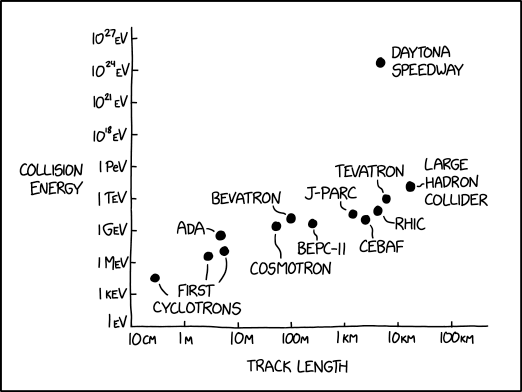
Fans at Daytona always get extra excited when officials decide to introduce some antimatter cars circling the track in the opposite direction.

Fans at Daytona always get extra excited when officials decide to introduce some antimatter cars circling the track in the opposite direction.