daily

2026-08-15
1

Calls to abolish hospital parking charges

Wexford Local · original → · 8/10 · Local Wexford: hospital parking charges affecting patients and families
By Dan Walsh Sinn Féin TD for Wicklow–Wexford Fionntán Ó Súilleabháin has called for a funded plan to phase out hospital parking charges, arguing that patients and families should not have to pay to…

By Dan Walsh

Sinn Féin TD for Wicklow–Wexford Fionntán Ó Súilleabháin has called for a funded plan to phase out hospital parking charges, arguing that patients and families should not have to pay to access healthcare.

According to Deputy Ó Súilleabháin figures provided by the HSE in response to a Parliamentary Question by Sinn Féin’s Spokesperson on Health, David Cullinane TD, show that hospital car parking income at Wexford General Hospital rose from €184,961 in 2022 to €303,846 in 2025 – a 64% increase.

[image →]
FIONNTÁN Ó SÚILLEABHÁIN TD

Deputy Ó Súilleabháin said told WexfordLocal.com: “Hospital car parking charges are a charge on being sick and visiting families and friends in hospital.

“No one chooses to be sick or to have a sick child in hospital. Yet patients and families in County Wexford are being asked to pay these charges repeatedly.

“People with disabilities, carers and families visiting loved ones in hospital are also being hit.

“The amount being raised through hospital parking has increased dramatically. Hospitals should not have to depend on money collected from sick people and their families.

“We need a funded plan to phase these charges out. The Government should provide replacement funding as charges are phased out, while ensuring hospital parking remains available for patients and visitors,” concluded Deputy Ó Súilleabháin.

2

Taoiseach urged to intervene over funding for rare neuromuscular condition drug

Breaking News Ireland · original → · 7/10 · Irish policy: HSE drug funding decision affecting rare disease patients
Taoiseach Micheál Martin has been urged to intervene to ensure there is “full transparency” around a recommendation to refuse funding for a drug used to treat the degenerative disease Friedreich’s…

Taoiseach Micheál Martin has been urged to intervene to ensure there is “full transparency” around a recommendation to refuse funding for a drug used to treat the degenerative disease Friedreich’s Ataxia. Sinn Féin leader Mary Lou McDonald said the decision of the HSE Drugs Group not to recommend Skyclarys for reimbursement had caused “deep distress among patients and their families”. Friedreich’s Ataxia is a rare progressive neuromuscular condition affecting around 200 people in Ireland. Earlier this week, the HSE Drugs Group made its recommendation, raising concerns about “limitations and uncertainties” associated with the efficacy of the drug and its current price. A final decision on the drug is expected to be made by the HSE later in August. But Ms McDonald has written to the Taoiseach on the issue. She said that Skyclarys “has been approved for use across the European Union since February 2024 and is now publicly funded or otherwise accessible in a number of European countries”. She said: “I am asking you, as Taoiseach, to intervene to ensure that there is full transparency around the HSE assessment, the findings of the Drugs Group and the basis upon which this decision was reached. “Patients and their families are entitled to know what evidence was considered, what factors determined the outcome and, crucially, what options remain open to them.” She also asked Mr Martin to meet “urgently” with young people with Friedreich’s Ataxia and their families. This matter cannot be allowed to drift through further administrative delay Ms McDonald also asked for the HSE meeting to make a final decision on the drug to be brought forward. She said: “Every available avenue for providing access to Skyclarys should now be examined urgently, including what can be learned from the arrangements already in place in other European countries. “This matter cannot be allowed to drift through further administrative delay. “These patients and their families have already waited for two years. “They deserve transparency, meaningful engagement and a clear pathway forward.” In a statement to RTÉ earlier this week, the HSE said its Drugs Group had “considered an assessment from the National Centre for Pharmacoeconomics which found that while there is some evidence that this drug may slow disease progression in Friedreich’s Ataxia, that there remain limitations and uncertainties associated with the available clinical efficacy data”. It said: “They also concluded that the current price was substantially above the level typically regarded as cost-effective in Ireland having regard to the limited efficacy of the drug.”

3

Google is making private AI practical with homomorphic encryption

Hacker News · original → · 7/10 · AI: Google homomorphic encryption for private AI inference
How Google is Making Private AI Practical with Homomorphic Encryption Today we're excited to showcase HEIR, the latest powerful tool added to our Private Computing Toolkit. HEIR is an open source…

How Google is Making Private AI Practical with Homomorphic Encryption Today we're excited to showcase HEIR, the latest powerful tool added to our Private Computing Toolkit. HEIR is an open source compiler that unlocks cryptographically-secure private AI inference. Homomorphic encryption As new benefits emerge with the growth of AI, balancing privacy and security is top of mind. Standard protections like end-to-end encryption present a trade-off: user-data can be protected from data breaches, but then the service provider cannot provide features that depend on the data, such as spam or virus detection. Critical sectors like healthcare and finance are even more averse to these risks, and strict regulations limit data sharing across institutions. Alternative mechanisms to provide the same features, like local processing, are limited by the capabilities of the local device and the sensitivity of the service provider's IP. Shipping proprietary AI to a device risks leaking the model. A solution to these issues is homomorphic encryption, a rapidly maturing technology that fundamentally alters this trade-off by allowing computations to be performed directly on encrypted data. Servers can process ciphertexts and return encrypted results without exposing any underlying information. For example, a cloud service can provide content recommendations without being able to see the user's features. This is no exaggeration: one of the demos featured in this post does exactly this. But while homomorphic encryption has a nontrivial cost overhead, it shifts the capability/privacy trade-off to a question of cost. And the cost of homomorphic encryption is rapidly decreasing. Google’s history of innovations in privacy technology—from differential privacy and private set membership to private information retrieval and secure enclaves on Google Cloud—has always focused on securing user data. Homomorphic encryption is another powerful tool we're adding to our private computing toolkit. Like private information retrieval, and in contrast to hardware-based solutions, homomorphic encryption's strong security and privacy guarantees are purely cryptographic. However, manually converting an existing program to use homomorphic encryption efficiently requires a team of cryptographers. About HEIR To overcome the usability challenges and advance the opportunity homomorphic encryption provides, researchers and engineers at Google built the HEIR compiler project. HEIR (Homomorphic Encryption Intermediate Representation) is an open-source compiler toolchain and development platform for homomorphic encryption. In particular, HEIR can convert pre-trained AI models that operate on unencrypted data to operate on encrypted inputs. Our vision is to make HEIR a one-click solution to enable non-experts to incorporate encrypted inference into production applications. Since announcing our intentions in 2023, we’ve seen the homomorphic encryption community embrace HEIR. We have partnered with companies developing hardware accelerators for homomorphic encryption, including Belfort, Niobium, Cornami, and Optalysys. The fruits of those efforts are shown in our demos below, and we plan to demonstrate the latency benefits of these accelerators in the near future. HEIR has also become a productive research platform. By building on HEIR, cryptographers can focus on their specific optimization and use the existing infrastructure for testing, benchmarking, and comparisons. This has resulted in collaborations with Georgia Tech, Carnegie Mellon, UC Santa Barbara, Illinois Institute of Technology, Purdue, the University of Edinburgh, Tsinghua University, and others. To date, four peer-reviewed publications were built on HEIR, with more in preparation, and HEIR has accumulated numerous citations. Applications of HEIR To demonstrate how far homomorphic encryption has come, we’re sharing four private inference applications. Each application was compiled with HEIR, and latency numbers are presented for a single-threaded CPU. The source code for all examples is available in our GitHub repository. - A Deep Learning Recommendation Model unlocks serving private content recommendations, joint work with Belfort Labs, LG, and New York University. - Credit card fraud detection: Together with Niobium and hardshell.ai, we compiled a credit card fraud detector. - Threat intrusion: Together with Niobium we compiled the Kitsune system for anomaly detection of encrypted network traffic. This allows a service provider to detect anomalies without revealing the contents of network packets to the service provider. - Hotword Detector: Together with Belfort Labs we compiled a hotword detection model, which could allow an audio-triggered AI agent to recognize hotwords while protecting the privacy of the audio recordings. As the software industry adapts to security and privacy changes amid AI, our research team is working to make homomorphic encryption, easy to develop, fast to run, and ubiquitous across industry.

4

Introducing Toast 1

Hacker News · original → · 7/10 · AI: Toast search agent performance and cost comparison
Introducing Toast 1 Toast 1, our first specialised search agent, is available today. It provides frontier search quality, matching or outperforming Claude Opus 5 and GPT-5.6 Sol while being up to…

Introducing Toast 1 Toast 1, our first specialised search agent, is available today. It provides frontier search quality, matching or outperforming Claude Opus 5 and GPT-5.6 Sol while being up to 10× cheaper and 12× faster. It performs best with Mixedbread Search, but it can work with any search backend. Today, frontier models are now able to perform real knowledge work. They can reason, analyse, and find information in complex document collections. But they are also the most expensive models in the stack. As intelligence is increasingly metered, the need for specialised agents able to match their capabilities at a fraction of the cost is greater than ever. Toast 1 can run as a standalone specialized retrieval agent, or as one of many subagents your frontier model already knows how to rely on. It fully takes over the search loop: given an initial query, it decomposes it into subqueries, gathers evidence, inspects sources, and curates the relevant context before returning it. This lets your agent spend its context and compute on the task that requires a generalist, frontier-level model: reasoning, acting, and producing the final answers. Pareto Optimal SearchLink to section This specialisation of agentic labor results in considerably cheaper search, but also in better end-to-end results on many realistic tasks. We found that Toast 1 establishes a new Pareto frontier across agentic workloads across cost per task and speed per task. Financial Analysis: OfficeQA Pro V2Link to section OfficeQA Pro V2, released by Databricks, evaluates answer correctness across 90 questions in realistic, complex enterprise financial situations. GPT‑5.6 Sol with Toast 1 made available as a sub-agent within Codex reaches 70% answer correctness at approximately $1.15 per task: that is the highest score among the systems evaluated by Databricks in the OfficeQA v2 release, establishing new state-of-the-art performance in both quality and efficiency. By comparison, the previous best performer, Claude Fable 5 on Databricks Genie, reaches 60% correctness at approximately $4 per task, while GPT-5.6 Sol within Codex without Toast 1 only reaches 33% correctness. This improvement stems from reformulating the economics of evidence gathering. Toast 1's specialization allows it to produce high-quality, token-efficient evidence packages, leaving ample resources for the reasoning process to reach the final answer. Legal Agentic Benchmark - Firm KnowledgeLink to section Harvey LAB's Law Firm Knowledge benchmark seeks to evaluate how well an agent can search and use institutional legal knowledge at large, realistic scales. Legal work, by nature, is context-heavy. You cannot outargue someone with access to better, more relevant precedents and details. But it is also noisy: many situations are similar but vary by simple details, making it tricky to collect high quality evidence packages without numerous false positives. On a randomly selected subset of 33 tasks,1 we found that GPT-5.6 Sol's answer quality remained constant across search methods. However, increasing search quality drastically increased token efficiency: replacing the vanilla agent's filesystem search with Mixedbread Search cut token usage from 80.6M to 47M at an identical task score. Subsequently adding Toast 1 as its dedicated search subagent reduced it further to 23M, and allowed it to finish in half the turns required by vanilla agent. The introduction of a Mixedbread Search-powered Toast 1 preserved answer quality, while consuming 3.5× fewer tokens, leading to a cost reduction of over 60%. Toast 1 frees up the context window of frontier models to let them spend their tokens on reaching the right answer. Demo: Dig Deep Into Dwarkesh's PodcastLink to section Benchmarks and numbers can only tell one part of the story. To truly understand how Toast 1 works, there is no better way than watching it search in action. At Mixedbread, we really enjoy Dwarkesh's podcast, and thought being able to search deep into its transcripts would be fun. You can try it yourself here. Frontier Class RetrievalLink to section Although it is a capable subagent for complex tasks, Toast 1 is also a capable standalone model, trained specifically for deep search. It represents the next step of our co-design approach behind our embedding models and Silo: the model, agent harness, and retrieval primitives are designed to work together.2 On a variety of deep search benchmarks, it reaches frontier model performance, standing in the same league as GPT-5.6 Sol and comfortably outperforming models such as Kimi K3 or GLM-5.2. It remains lightweight in doing so. A standard Toast 1 run costs approximately 0.023 per query and has an eight-second median latency. Our highest-quality fusion configuration costs approximately 0.07 per query and has an eleven-second median latency. In practice, among the systems in our evaluation that reached similar performance, Toast 1 was 7–11× cheaper and considerably faster: Frontier-model retrieval agents took between 20 seconds and four minutes on the same evaluation. Availability and PricingLink to section Toast 1 is available immediately through the Mixedbread API at the discounted launch pricing: - $0.30 per million input tokens - $0.036 per million cached input tokens (cache writes are free) - $0.72 per million output tokens Mixedbread search invoked by Toast 1 is priced at a special rate. With Your Existing Retrieval StackLink to section Toast 1 was co-designed with Mixedbread Search's primitives and will be at its strongest performance with it. But we put special care in ensuring that it remains backend agnostic: it can run over your existing retrieval indexes, and does not require migrating your existing backend. We conducted thorough testing to ensure that Toast 1 remains competitive with the performance of frontier models in similar conditions at a fraction of the cost and latency, no matter the provided index. You can use Toast 1 with our Chat Completions API and add it as a retrieval tool to your existing agentic workflows in just a few minutes. Here is a golden harness you can use directly. With Coding AgentsLink to section Let your coding agents handle the integration with npx skills add mixedbread-ai/skills . Or use Toast 1 directly as a subagent with our OpenCode integration. With Your Mixedbread StoresLink to section Get an API key with $5 in included credits to try it out. FootnotesLink to section - We evaluated a randomly selected subset of 33 tasks to make repeated comparative runs tractable. Every configuration used the same tasks and evaluation setup; only the retrieval stack changed. ↩ - Toast 1 is part of a growing body of work on specialised search agents, alongside SID-1 and Chroma's Context-1. While each takes a different approach, they share the goal of bringing frontier-level retrieval to production at lower cost and latency. ↩
5

Why does Opus 5 feel worse to work with?

Hacker News · original → · 7/10 · AI: Claude Opus 5 user experience analysis and comparison
Why does Opus 5 feel worse to work with? In my opinion and that of the colleagues I've spoken with, working with Opus 5 feels like a downgrade compared to Opus 4.7, Opus 4.8, and Fable. I'm not…

Why does Opus 5 feel worse to work with? In my opinion and that of the colleagues I've spoken with, working with Opus 5 feels like a downgrade compared to Opus 4.7, Opus 4.8, and Fable. I'm not claiming a step backwards in capabilities – it is a more capable model than Opus 4.7 and Opus 4.8 and even rivals Fable in benchmarks, yet these other models feel better to work with. I believe this is because they: - stop and ask questions if my intent was unclear, - don't make assumptions without checking, - and don't reinterpret or update my plans without asking. Because of this, they don't require the careful babysitting that Opus 5 does. Baseless speculation I suspect this is the result of two compounding forces at Anthropic, and in current frontier labs in general. First, the desire to create a self-improving AI that is capable of recursively bootstrapping itself to AGI/ASI. Second, the pressure to score highly on benchmarks. Although it's an open secret that many benchmark tasks are ill-defined, unfair, hackable, or otherwise broken, a good benchmark task is self-contained. It can be solved. It doesn't require hints, reading the task creator's mind, or outside information to pass. That doesn't mean a good task can only have one correct answer, just that it should score all unambiguously correct answers equally. Selecting for models that do well on benchmarks (and indeed training for them or on RLVR tasks in general) inherently selects for models that make bold, usually-correct assumptions in the face of ambiguity. It penalizes models with a tendency to stop and ask for clarification or direction. Unfortunately, that's exactly what most of us want from a coding agent. Try as you might, it's nearly impossible to get the entirety of the context, intentions, business implications, budget constraints, and what-have-you written down and accessible to a coding agent. There will invariably be ambiguity and choices to be made, and it is nice to know that an agent will stop and ask when needed. Real life just isn't a benchmark. There isn't a guaranteed right answer to every question, nor even a set of right answers, and with real-life consequences on the line, I do not want an agent taking its best guess!

6

The Tokenpocalypse Is Here: Companies Are Scrambling To Stop Spending So Much on AI

Simon Willison · original → · 7/10 · AI: critical perspective on AI token spending and costs
7th August 2026 - Link Blog The Tokenpocalypse Is Here: Companies Are Scrambling To Stop Spending So Much on AI (via) There's a fun anecdote from Accenture (apparently via leaked meeting audio…

7th August 2026 - Link Blog The Tokenpocalypse Is Here: Companies Are Scrambling To Stop Spending So Much on AI (via) There's a fun anecdote from Accenture (apparently via leaked meeting audio recordings) in this 404 Media piece from June 24th: “We’re seeing from some of the data internally at least that it’s actually not our engineers that are driving the token consumption. It’s a lot of the non-engineers that are doing some of those behaviors [...] you were talking about,” Justice Kwak, Accenture’s agentic AI strategy lead, said [...] Stuart Henderson, Accenture’s client group lead, interrupts. He jokes he hopes Kwak didn’t just convert a PDF into images and then into markdown files. “I’m learning that’s one of the big token chewers,” Henderson says. “Turning PDFs into markdown: is that right?” That’s when Kwak says that’s what Accenture’s own data shows. Maybe if Accenture figure out that PDFs are a terrible medium for communicating information they'll be able to push that message out to the rest of the business world too!

Items scoring 7/10 or above from 11 sources, scored by claude-haiku-4-5-20251001 on relevance to my interests. At most 3 per source.

Scoring categories & sources
  1. Local Wexford or South East Ireland news
  2. Irish or EU-wide affairs affecting citizens broadly: elections, new laws or policy being debated, cost of living, education — especially impacts on mid-life adults or teenagers. Never courts/crime stories.
  3. Irish news on a topic relevant to my interests
  4. Work and tech topics: networking, AI, Kubernetes, platforms, SaaS
  5. AI news including critical or anti-AI perspectives
  6. Gaming: PC gaming, indie gaming, retro gaming
  7. General interests: gardening, woodwork, cycling, fitness, travel
  8. Comics

Sources: Breaking News Ireland, Wexford Local, Hacker News, r/gaming, r/pcgaming, r/antiAI, r/indiegaming, Lenny's Newsletter, One Useful Thing, Newcomer, Simon Willison

Comics

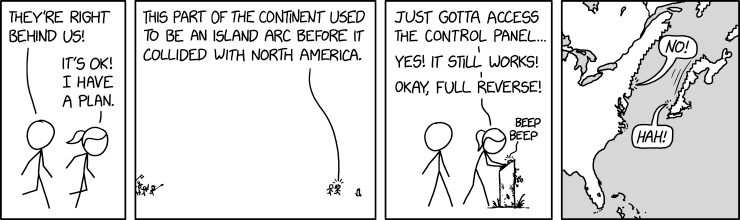
Accretionary Arc

XKCD · view →
The late Triassic rifting was caused by a dinosaur trying to use the control panel to escape a predator, but it was eaten before the continent could fully separate.

The late Triassic rifting was caused by a dinosaur trying to use the control panel to escape a predator, but it was eaten before the continent could fully separate.