daily

2026-06-25
1

Cllr John Fleming elected in New Ross

Wexford Local · original → · 8/10 · Local Wexford: New Ross municipal council election
[image →]CLLR JOHN FLEMING elected Cathaoirleach of New Ross Municipal District for the third time today. (Pic; WexfordLocal.com) By Dan Walsh at The Tholsol, New Ross Fianna Fail’s Cllr John…
[image →]
CLLR JOHN FLEMING elected Cathaoirleach of New Ross Municipal District for the third time today. (Pic; WexfordLocal.com)

By Dan Walsh at The Tholsol, New Ross

Fianna Fail’s Cllr John Fleming from Palace West, Clonroche, this afternoon became Cathaoirleach of New Ross Municipal District for the third time at the annual meeting in The Tholsol, New Ross.

Proposed by Cllr Pat Barden and seconded by Cllr Bridín Murphy, Cllr Fleming assumed the Chair he previously held in 2018/’19 and 2019/2020 and said he was “delighted and honoured”, is looking forward to working with members and staff, “and I’ll carry out my demands. No problem”

Well-known in handball and GAA Cllr Fleming was first elected at the Local Elections in 2014, has retained his seat in all election’s since, and was Cathaoirleach of Wexford County Council during the 2023-’24 season.

Tributes followed. Cllr Bridín Murphy said she was delighted for Cllr Fleming; “We come from the same parish. We are a team here. I wish you well and is always here to support you,” added Cllr Murphy.

In his praise, Cllr Michael Sheehan predicted that “the year ahead will be very exciting.” Cllr Pat Barden said projects in the town are moving in the right direction but offered his backing support for projects outside the town and in the districts.

Cllr John Dwyer called on the Cathaoirleach saying; “We need affordable housing in New Ross. Can you make that a priority? I believe you have the passion to do it.”

Cllr Bridín Murphy proposed Cllr Michael Sheehan for the position of Leas-Cathaoirleach; Cllr John Dwyer seconded the nomination. It was pointed out that Cllrs Sheehan and Dwyer are the longest serving members having been elected to the defunct New Ross Town Council.

“I would like to thank the officials for what was a great year in terms of activity,” commenced outgoing Cathaoirleach Cllr John Dwyer.

In a light-hearted remark Cllr Dwyer said he would also like to thank the members “for behaving themselves” (laughter) and said he tried to be fair when members came in multiple times on the same issue! That said, “I thank all the members for their co-operation during the year and, indeed, the officials,” said Cllr Dwyer.

Cllr Michael Sheehan congratulated Cllr Dwyer saying, “you were immensely fair, treated all with dignity and respect and you were passionate about the town and district.”

“Extremely fair” were the words of Cllr Marty Murphy, while Cllr Pat Barden said Cllr Dwyer was “very fair, very genuine, 100%, and you did a brilliant job.”

Cllr Bridín Murphy mentioned “the legend that is John Dwyer. You are incredibly passionate about what you do. An absolute gentleman that cares for everything.”

Leas-Cathaoirleach Cllr John Fleming said; “it was a great positive year for the Council and we worked well together.”

There were also tributes from District Manager Alan Fitzhenry and Director of Services Eamonn Hore. Mr Fitzhenry gave a resumé of projects undertaken during the year, while Mr. Hore pointed out that “it is the little things that matter and a lot of good things have started for the year ahead.”

2

Water outages in Campile and Great Island

Wexford Local · original → · 8/10 · Local Wexford: water outages in Campile and Great Island
[image →] By Dan Walsh Uisce Éireann crews are responding to a water outage impacting Campile, Great Island and surrounding areas following a burst on a trunk watermain. To support customers, a…

By Dan Walsh

Uisce Éireann crews are responding to a water outage impacting Campile, Great Island and surrounding areas following a burst on a trunk watermain.

To support customers, a water tanker will be in place in Campile village today, with additional water available via IBCs at Horeswood Church and at the local GAA pitch. Customers are advised that water from tankers and static tanks should be boiled before consumption as a precaution.

Following works yesterday to connect a new watermain serving Great Island, supply was initially restored. However, a burst occurred at approximately 8pm last night, and the water supply was subsequently turned off to protect the network, impacting customers in Campile, Great Island, Horeswood and parts of Burkestown.”

Efforts were made overnight to begin refilling the reservoir. Crews are on site today (Wednesday) to locate and repair the burst, with repairs expected to be completed by approximately 4pm today. Uisce Éireann’s Water Operations Manager for Wexford,

Padraig Lyng, acknowledged the disruption to homes and businesses:
“We understand the significant impact this unplanned outage is having on the communities of Campile, Great Island, Horeswood and surrounding areas. Our crews are working to restore supply as quickly and as safely as possible.

“Our priority today is to locate and repair the burst. We thank the community for their continued patience while these essential works are carried out,” stated Mr. Lyng.

Customers may continue to experience low pressure or outages until repairs are completed and the network refills. Typically, it can take a number of hours following repairs for normal supply to return to all customers, particularly for those at the end of the network or on higher ground.

3

GLM 5.2: why I’m replacing Opus in Claude Code with this new model

Lenny's Newsletter · original → · 8/10 · AI/work: GLM 5.2 coding model practical evaluation
I put GLM 5.2, the open-weight coding model from Z.AI, through four real tasks inside my actual codebase: a codebase architecture audit, a UI redesign, and a 45-minute autonomous bug-hunting session…

I put GLM 5.2, the open-weight coding model from Z.AI, through four real tasks inside my actual codebase: a codebase architecture audit, a UI redesign, and a 45-minute autonomous bug-hunting session pulling from Sentry and Vercel logs. Total cost: $3.36 for roughly 6 million tokens, a prioritized bug-fix dashboard I’m actually shipping from, and a landing page redesign that matched Chat PRD’s design system on the first try.

Listen or watch on YouTube, Spotify, or Apple Podcasts

What you’ll learn:

  1. What “open-weight” actually means and why it matters for cost and vendor independence

  2. How to connect GLM 5.2 to Cursor and Claude Code

  3. How it performs on codebase exploration and autonomous architecture summarization in a real production Next.js app

  4. Whether GLM 5.2 can match an existing design system

  5. How the model handles a 45-minute long-running autonomous task

  6. Where GLM 5.2 stumbled

  7. The actual cost breakdown


Brought to you by:

Mercury—Radically different banking loved by over 300K entrepreneurs

In this episode, we cover:

(00:00) What open-weight models are and why GLM 5.2 is worth testing

(01:38) GLM 5.2 model overview

(04:02) Capabilities and benchmark results

(06:02) How to set up GLM 5.2 in Cursor

(08:37) How to set up GLM 5.2 in Claude Code

(11:04) Live test 1: codebase exploration and architecture audit on ChatPRD

(12:43) Live test 2: generating an HTML architecture and roadmap page

(16:37) Live test 3: redesigning the How I AI landing page in Cursor

(20:57) Live test 4: 45-minute autonomous task, pulling Sentry errors and Vercel logs

(22:35) Where it struggled

(23:49) My verdict on the output

(25:23) Cost breakdown

Tools referenced:

Other references:

Where to find Claire Vo:

ChatPRD: https://www.chatprd.ai/

Website: https://clairevo.com/

LinkedIn: https://www.linkedin.com/in/clairevo/

X: https://x.com/clairevo

Production and marketing by https://penname.co/. For inquiries about sponsoring the podcast, email jordan@penname.co.

4

What the papers say: Thursday's front pages

Breaking News Ireland · original → · 7/10 · Irish affairs: heatwave and drugs policy debate affecting citizens
Here are the stories making headlines this Thursday. The punishing heatwave that has swept across Europe, during which temperatures have climbed to unprecedented highs, is set to continue on…

Here are the stories making headlines this Thursday. The punishing heatwave that has swept across Europe, during which temperatures have climbed to unprecedented highs, is set to continue on Thursday, The Irish Times reports. Ireland is bracing for the hottest day of 2026, possibly smashing a 150-year record. The Irish Examiner leads with an Oireachtas committee saying Ireland needs to take its head “out of the sand” about the drugs crisis and decriminalise the personal possession of drugs. With cross-party support, the Oireachtas drugs committee called for the offence of possession — for all drugs — to be removed from the statute book. More than 500 Ukrainian residents living in the former Trabolgan holiday village have been told they will soon have to leave the East Cork facility they have been calling home, according to The Echo. The residents of Trabolgan, now one of the largest accommodation locations for Ukrainians in the State, include 167 children, 74 pensioners, and 10 disabled people. Food prices are likely to continue rising in the coming months due to the delayed effects of the Iran war, ESRI has warned. While there has been an inflation shock from the closure of the Strait of Hormuz, it was mostly limited to oil and gas, the Irish Independent reports. ESRI predicts the cost of food is likely to increase towards winter. “The impact of the war in the Middle East on food prices in Ireland is yet to be felt,” says its summer economic commentary. Nikita Hand has thanked singer Pink after she criticised Conor McGregor's appearance on Jimmy Fallon's Tonight Show in the US, according to the Irish Daily Mirror. McGregor, who was found by a civil jury to be liable for the rape of Hand, was on the talk show last week. The Irish Daily Star leads with doctors warning the public to stay out of the sun during the heatwave, and not even think about getting a tan. A recommendation by TDs and senators to decriminalise all drugs has sparked outrage and been branded by doctors as ‘very dangerous’ as it will lead to ‘more broken lives’, the Irish Daily Mail reports. Members of the cross-party Joint Committee on Drugs Use have called for the possession of drugs for personal use – including cocaine and heroin – to be allowed. Riad Bouchaker “went for the smallest children he could find” when he is alleged to have attempted to murder two five-year-olds and a six-year-old in Dublin, according to The Herald. Det Gda Gary Moran suggested that Bouchaker demonstrated “restraint and patience” as he waited in the Parnell Square area for 37 minutes. He also searched for a specific school on his mobile phone and asked a number of people for directions and inquired as to what time classes would finish.

5

NTA writes off €1.5m spent on failed IT projects, including abandoned digital Leap Card plans

Breaking News Ireland · original → · 7/10 · Irish affairs: public IT spending failures affecting transport
The National Transport Authority (NTA) has written off almost €1.5 million in respect of failed IT projects in the past five years, including abandoned plans for a virtual Leap Card. It follows the…

The National Transport Authority (NTA) has written off almost €1.5 million in respect of failed IT projects in the past five years, including abandoned plans for a virtual Leap Card. It follows the revelation that Iarnród Éireann had written off €50 million that it had spent on a new IT system for monitoring and managing rail traffic, which was subsequently abandoned. The NTA is the approving body for capital spending on IT systems by Iarnród Éireann. It has now emerged that the agency itself has also written off a seven-figure sum on IT projects that were subsequently cancelled, abandoned or failed to go live. Records provided to Aontú leader Peadar Tóibín in response to a parliamentary question show that €1,448,718 was wasted on plans for a centralised TaxSaver solution between March 2020 and October 2022. A further €42,918 was spent on plans for a virtual Leap Card that commuters could keep in their digital wallets between June and December 2023. However, this was cancelled after “feasible options were not deemed suitable”. Less than four months later, a proposal for a virtual Leap Card was a finalist at the NTA’s Smarter Travel Student Awards, with the project declaring: “There is no reason why Transport for Ireland can’t roll out the technology to all commuters.” The NTA appeared to disagree, however, as it found that technical requirements for Apple phones meant that the Leap Card could not have worked on these devices until ticketing programmes were upgraded. This would have excluded commuters with Apple phones for at least 12 months, so senior management decided not to proceed with the project, according to the records provided to Mr Tóibín. Plans for a centralised TaxSaver solution were commenced in March 2020 with an initial budget of over €4.6 million. More than 30% of this had been spent by October 2022, when a decision was made to abandon the project. “Due to delivery delays, the ongoing viability of the project was questioned and, after executive review, the project was cancelled,” said the NTA. This decision was taken because the Covid-19 pandemic had changed travel patterns, and the value offered by the scheme was reduced to a point where it was significantly less attractive for much of the target market, it added. “There were no signs of a return to previous patterns of use and calls [were] made for a new approach that would more suit current and expected future hybrid working/travel arrangements,” the records read. A decision was therefore made to cease work on the proposed centralised solution, and the NTA decided to focus on “more suitable alternatives” to meet changing transport needs. Mr Tóibín said the latest revelations regarding write-offs on IT expenditure in the transport sector were symptomatic of “waste and incompetency”. “This comes in the wake of the recent €50 million Irish Rail failed IT project – a major waste scandal that has simply just disappeared off the radar, seemingly without consequence,” he said. “One part shows nearly €50,000 spent trying to get digital Leap Cards. We’re surely one of the last countries where you still have to carry the physical cards, but it still could not be modernised. “This flagrant spending on what ends up as failed IT projects has to end. The citizen loses twice,” he added.

6

GLM-5.2 is a step change for open agents

Hacker News · original → · 7/10 · AI: GLM-5.2 open agent model capabilities
GLM-5.2 is the step change for open agents A capability threshold I've been carefully monitoring. Housekeeping: Following my “State of the blog” post last week, noting a slight increase in paid…

GLM-5.2 is the step change for open agents A capability threshold I've been carefully monitoring. Housekeeping: Following my “State of the blog” post last week, noting a slight increase in paid features, it’s a good time to remind folks that I offer group subscriptions with larger discounts proportional to the number of seats. I also released a new paper today on open RL recipes for terminal agents, read more here. A bit over a week ago, when the AI world was still reeling from the shocking export restriction, and effective banning, of Claude Fable 5, Z.ai released their latest model, GLM-5.2. This model was rolled out unusually on a Saturday, June 13th, to GLM Coding Plan members. This is an unusual release practice, normally when an AI model is released on a weekend it’s for a weird reason (most famously, Llama 4).1 In this case, it seemed like Z.ai was excited to capitalize on the zeitgeist of “Anthropic being anti open-science” with their silent safeguards on AI researchers. For the past year or two, the Chinese open-weight labs have taken every opportunity they have for easy marketing wins like this. GLM-5.2, in a common naming convention across the industry, looked potentially like an incremental update following the popular GLM-5.1 model. At this point, Moonshot AI, makers of the Kimi models, and Z.ai, makers of the GLM models, have consolidated the top of the reputational market with the most beloved open-weight models among AI researchers. What unfolded is a common lesson in tracking AI models that often minor version numbers can have AI models crossing meaningful user experience thresholds. A small change in benchmarks and training can open a wide range of new use-cases. What has followed is a slow, groundswell of hype for GLM-5.2. The official, MIT-licensed model weights and release blog dropped three days after the initial rollout, on June 16th. One could ramble many technical details, such as the strong benchmark scores, the very popular RL framework that Z.ai uses (SLIME), the recommendation of always using the model on Max thinking effort, and so on, but the initial release blogs usually aren’t the thing to focus on. You can wait and read the ecosystem reaction to know if it’s the real deal. Benchmarks are half dead these days, anyways. What followed on the 16th was a slew of community benchmarks showing better-than-expected results for GLM-5.2. Arena’s agent leaderboard had it as the only open model mixing it up with OpenAI and Anthropic’s latest models (notably matching Opus 4.8’s no-thinking effort to GLM-5.2’s max mode). This is one of many evals GLM-5.2 is crushing Gemini on, but that’s a topic for another time. A benchmark that has mixed perception in the community (particularly among actual designers), Design Arena even had GLM-5.2 besting Claude Fable itself — the recently banned hype machine! Pretty much everyone I respect among the AI commentariat and researcher class has praised the model after using it personally. Such a focal point of discussion among the community has only been so clear with an open model release once before — DeepSeek R1. This is not a comparison I make lightly, and when I compared Kimi K2’s release to a “DeepSeek Moment,” GLM-5.2 has well exceeded that. What made Kimi K2 impressive was that big steps in open model performance could seemingly come from anywhere in China. The step that GLM-5.2 has taken is more of a one way door for AI progress. Anthropic’s record revenue growth rate on the back of Claude Code is heavily driven by being the best model, and the only model that can really do this. GLM-5.2 is the first of many (coming soon) open weight models to offer credible alternatives. The parallel is very clear, to when DeepSeek R1 showed that open-weight labs, with far fewer resources, could also replicate the chain-of-thought reasoning models that OpenAI championed with o1. As AI systems get more complex and far more expensive to build, with tools, integrated harnesses, and scaled model weights, it was not a given that this GLM-5.2 moment would happen at all. The key point is that GLM-5.2 is the open weight model that feels right in coding harnesses as a general agent. It’s the first one. I was personally overdue in trying some of the recent peer models, such as Kimi K2.7 or GLM-5.1, but the hype was too much for me to ignore. I put it to work helping make content for my post-training course with Fireworks’ API in Claude Code (setting this up was very easy). There were some minor knife cuts, such as the Claude Code harness / my repo documentation trying to send images to the model, which would brick Fireworks API for the session — forcing a manual context clear. Overall, the model capabilities immediately felt right, and I still have some tinkering to do in which harness and inference provider to use. For more hype, you can sample the Z.ai founder telling Elon that “open-weight Fable capabilities will be here sooner than Q1 2027,” the CEO of Vercel saying “Genuinely impressed, almost shocked, at how good GLM-5.2 by @zai_org is at coding. This changes things,” and much more from a mix of people whose opinions I deeply respect and others I’m new to. So, this is a good model, where does this leave us? There are many trends at play. To start, let’s ground things in the open-closed capabilities gap. I’ve written how I expect an “explosion in usage” if open models crossed the Opus 4.5 in Claude Code threshold from around the start of 2026. Here we are. With Claude Opus 4.5’s release on November 24th, 2025, the gap in time to GLM-5.2’s release on June 16th, 2026 is 204 days — or about 6.8 months. This puts us square in the 6-9 month time gap that many people claim as the performance lag between the U.S.’s closed labs and China’s open counterparts. Upon writing this, I’m surprised. As the U.S. labs have so rapidly ramped compute in the last ~year, I’ve expected the gap in performance to grow in time. A very meaningful step in this trajectory will also be Claude Fable 5’s release — which was more reliant on scale, and therefore the most advanced GPUs, relative to the Claude Opus models. Still, that’s not a satisfactory answer. Continuing to unpack the trajectory here involves more nuance than I can afford to fit in a signposting article. The most immediate meaning of this is far more serious pricing pressure within the organizations tokenmaxxing, sending Anthropic’s revenue to the moon. Some would predict Anthropic doesn’t realize its forecasted ARR numbers, but I don’t think that prices in the true demand for these models and the inevitable growth. This model existing is a huge boon for the open model economy. All the likes of Fireworks, Together, Thinky (via Tinker), Prime Intellect, and whoever else sells open model inference or finetuning just hit another inflection point. It’ll take a long time for the effects here to diffuse into the broader economy (and use-cases). Workflows are becoming more complex, with people using different models for planning, primary coding, and subagent dispatch. I expect the hype to continue to grow, and heck, as I’m writing this on a Sunday evening, I could see the media and market reaction on the Monday being a thing just like the DeepSeek R1 release. This diffusion happening while Anthropic’s, and by extension the U.S.’s flagship model, is still banned is a severe economic dagger. GLM-5.2 is being given time to carve out the economic underbelly of the frontier labs when they want to be pushing forward into higher margin, higher revenue domains enabled only by the absolute frontier models. The economic concern mirrors a story that has been told many times in AI, so it’s unclear when it’ll stick. The conversation that feels more core to the trajectory of AI is that of regulation and control of open models. I think it is an economic good for cheap intelligence to diffuse widely, and our default position should be to cheer for open models, but this model’s release date will have it be permanently associated with Claude Fable — and therefore Claude Mythos — in the mental map of AI power structures. We are at a point where Mythos-class model capabilities are deemed not safe for release by the U.S. Government and the Chinese model makers are charging forward in capabilities available to all. These trend lines aren’t necessarily causally linked, as we don’t know the cyber performance of GLM-5.2 versus its predecessors, but the capabilities are definitely correlated. Without anything changing, this points to a potentiality where the U.S. Government decides a certain open-weights Chinese model is not safe for the public. There are many other potential scenarios here too, but what is clear is that we have a lot of work to do in mapping them out, preparing our infrastructure, and messaging to society. It’ll take a lot more people than just me to imagine and communicate a world to decision makers for how to manage evermore capable open models.2 We have years more of AI progress to come, with Nvidia’s next generation chips already in production and a constant stream of algorithmic advancements. It feels like a narrow path for open model advocates to take, but we need to figure out how to make them viable so the massive leaps in performance don’t only go to closed models. I totally see why it is scary to imagine an openly accessible Mythos class model, but if open models get banned now and only closed models get 10 or 100X better in 2 years in the hands of one or two companies, I think we will have bigger problems on our hands. Something that has always stood out to me is how fast the Chinese labs release their models. I’ve heard from multiple labs that the time to upload the weights publicly to HuggingFace after the model finishes training could be measured in hours rather than days. This has at least slowed a bit, now that they need to prepare to serve the model to a wider inference market. Something that will need to be discussed more is how even closed models, e.g. Mythos preview, are regularly in the hands of unauthorized users or jailbroken. So, the open vs. closed dichotomy on access isn’t totally black and white.
7

Show HN: Write SaaS apps where users control where their data is stored

Hacker News · original → · 7/10 · Work/tech: SaaS database platform with user data control
LinkedRecords is a NoSQL database that you can connect to directly from your single-page application - no backend code required. Want to build apps with LinkedRecords? Check out the documentation…

LinkedRecords is a NoSQL database that you can connect to directly from your single-page application - no backend code required. Want to build apps with LinkedRecords? Check out the documentation website: - Introduction - Learn what LinkedRecords is and how it works - Getting Started Guide - Step-by-step guide to build your first app The chart below shows the performance of core operations as the database grows. This is automatically updated after each merge to main. The load test simulates a realistic document management scenario. Each createDocument operation creates a blueprint of 8 attributes (7 KeyValueAttributes + 1 LongTextAttribute) including the document content, collaborator/reader groups, comments, references, and configuration. The fetchDocuments operation lists all documents for a user, while fetchDocument retrieves a single document with all its associated attributes. The test simulates a multi-tenant environment with three users: - User 1 continuously creates documents (in the current test configuration 5,000 iterations). - User 2 is the "user under test" who creates one document for every 10 documents User 1 creates, up to 300 documents. At 300 documents, the creation of documents for this user stops. - User 3 creates documents occasionally (every 1,000 iterations) The x-axis shows the total number of documents in the database (owned by all users combined). The y-axis shows the response time in milliseconds. What's being measured: | Operation | Description | |---|---| createDocument | Time to create a new document with all related attributes (content, config, comments, references, collaborator/reader groups). You can see that createDocument is independent of the total amount of documents in the database as well as the amount of documents visible to the user. | fetchDocuments | Time to fetch User 2's document list (up to 300 documents they see). You can see that this time depends on the amount of documents visible to the user but not on the total amount of documents (the graph flattens around 3000 documents) | fetchDocument | Time to fetch a single document with all related data (content, comments, groups, activity state, references). You can see that this time depends on the amount of documents visible to the user but not on the total amount of documents (the graph flattens around 3000 documents) | You can think of LinkedRecords as a bucket where anyone can sign up and insert data. As long as you don’t share this data with other users or groups, only you can access what you’ve written into it. In theory, any user could use the LinkedRecords API directly to write and retrieve data. However, this would be inconvenient - just as you wouldn’t expect your users to write SQL queries, you wouldn’t expect them to interact with the LinkedRecords API. A LinkedRecords app is a specialized frontend that hides the API and provides a convenient user interface for accomplishing their tasks. In the traditional SQL world, inconvenience isn’t the only reason you don’t let users access the database directly - authorization concerns are an even stronger reason. With LinkedRecords, this is no longer an issue: authorization is built directly into the API. This requires a small mindset shift: Instead of defining universal authorization rules in the backend for all records, the user who inserts a data record specifies who can read it. For the LinkedRecords API, simplicity, flexibility, and a decoupled architecture are the main qualities we strive to achieve. - Simplicity: The API should not have many endpoints or methods; instead, it consists of a few fundamental building blocks. - Flexibility: The few available endpoints can be composed to support a variety of use cases. The backed in authorization model should allow to implement different authorization use cases (RBAC, ...). - Decoupled: LinkedRecords should be decoupled from the single-page applications which use it as data storage Think of it as SQL you can call directly from your React app without worrying about permissions; it is easier to read than SQL and provides live updates. LinkedRecords is configured via environment variables. See tables below. | Environment Variable Name | Example | Description | |---|---|---| | PGHOST | localhost | The hostname of the PostgreSQL server. | | PGUSER | linkedrecords | The PostgreSQL user name. | | PGPASSWORD | xxxx | The PostgreSQL password. | | PGDATABASE | xxxx | The PostgreSQL database name. | | CORS_ORIGIN | ["https://app.example.com", "https://app.example.app"] | The content of the cors origin header. If not provided, the value of FRONTEND_BASE_URL will be used. | | SERVER_BASE_URL | http://localhost:6543 | The public URL of the linkedrecords server. | | DEFAULT_STORAGE_SIZE_QUOTA | 500 | The default storage size quota in MB. | | QUOTA_COUNT_KV_ATTRIBUTES | false | If the storage space for KeyValue attributes are deducted from the accountee quota. | | QUOTA_COUNT_LT_ATTRIBUTES | false | If the storage space for LongText attributes are deducted from the accountee quota. | | ENABLE_AUTH_RULE_CACHE | false | Enable cache for authorization lookups. Might require a lot of memory. | | SHORT_LIVED_ACCESS_TOKEN_SIGNING | xxxx | Configuring this is optional but can reduce load on the database because short lived access token will be used for checking access when a client subscribes to attribute changes. | The environment variables in this section are all optional if the configuration described in the section "Public Client Mode" are provided. If LinkedRecords runs in confidential client mode, then a session token will be stored in an HttpOnly cookie. From a security standpoint this is considered the suggested method. However, this is not possible if the LinkedRecord server and the frontend do not share the same domain. Across different domains the cookie becomes a third-party cookie, so this mode cannot be used. | Environment Variable Name | Example | Description | |---|---|---| | FRONTEND_BASE_URL | http://localhost:3001 | The base URL of the frontend. It will be used for the Access-Control-Allow-Origin HTTP header and is also required for the OpenID connect redirection. | | AUTH_ISSUER_BASE_URL | https://xxx.us.auth0.com/ | The URL of the OIDC issuer. Can be any OpenID Connect compliant identity provider (e.g. Auth0, Okta). | | AUTH_CLIENT_ID | The client id. Can be obtained from the identity provider. | | | AUTH_CLIENT_SECRET | The client secret. Can be obtained from the identity provider. | | | AUTH_IDP_LOGOUT | true | When set to true the user session will be destroyed in the application AND the within the identity provider. | | AUTH_COOKIE_SIGNING_SECRET | xxxx | The secret used to sign cookies. | In case the single-page application is hosted on a different domain than the LinkedRecords server, the single-page application has to store the access token in the browser. In this scenario the following environment variables need to be configured. | Environment Variable Name | Example | Description | |---|---|---| | ALLOW_HTTP_AUTHENTICATION_HEADER | true | Allows public clients to make requests by providing an access token via http authentication header. | | AUTH_ISSUER_BASE_URL | https://xxx.us.auth0.com/ | The URL of the OIDC issuer. Can be any OpenID Connect compliant identity provider (e.g. Auth0, Okta). | | AUTH_TOKEN_AUDIENCE | your-audience-id | LinkedRecords will check the audience specified in the JWT bearer token against the value specified in this field. | | AUTH_CLIENT_ID | The client id. Can be obtained from the identity provider. | The single-page application needs to initialize the LinkedRecords SDK as shown below: import LinkedRecords from './src/browser_sdk'; const oidcConfig = { client_id: 'your-client-id', redirect_uri: window.location.origin + '/callback', }; // Instantiating LinkedRecords will automatically handle the OIDC redirect callback const lr = new LinkedRecords(new URL('https://your-backend.com'), oidcConfig); // To check if the user is authenticated: // const isAuth = await lr.isAuthenticated(); // To start login flow (e.g., on a button click): // lr.login(); If S3 is configured it will be used to store blob attribute values. If it is not configured they will be stored in PostgreSQL database. It is recommended to configure S3. | Environment Variable Name | Example | Description | |---|---|---| | S3_COPY_FROM_BL_ATTRIBUTE_TABLE | false | This is used for migration blob storage from postgresql to S3. | | S3_ENDPOINT | s3.system.svc.cluster.local | The hostname of the S3 endpoint. | | S3_BUCKET | linkedrecords-blobs | The name of a bucket. The bucket must exist already. | | S3_ACCESS_KEY | xxx | The access key id to upload blobs to S3. | | S3_SECRET_KEY | xxx | The secret key id to upload blobs to S3. | | S3_USE_SSL | false | Do not use TLS when uploading/downloading to S3. | | Environment Variable Name | Example | Description | |---|---|---| | PADDLE_NOTIFICATION_SECRET | xxxx | If paddle is used for upgrading quotas this needs to be the notification secret to verify the signature of the webhook content. | | PADDLE_API_URL | https://sandbox-api.paddle.com | The URL of the paddle api. | | PADDLE_API_KEY | xxx | the paddle API key. |

8

Computer use in Gemini 3.5 Flash

Hacker News · original → · 7/10 · AI: Gemini computer use agentic capabilities
Introducing computer use in Gemini 3.5 Flash Computer use is now a built-in tool supported in Gemini 3.5 Flash, delivering our best performance yet for agentic computer use tasks. Previously only…

Introducing computer use in Gemini 3.5 Flash Computer use is now a built-in tool supported in Gemini 3.5 Flash, delivering our best performance yet for agentic computer use tasks. Previously only available as a standalone Gemini 2.5 computer use model, computer use is now integrated natively in the main Gemini Flash model. Gemini already excels at function calling and using built-in tools like Search and Maps grounding. With built-in computer use capability, developers can now use 3.5 Flash to reliably build custom agents that can see, reason and take action across browser, mobile and desktop environments. This unlocks improved performance for long-horizon and enterprise automation tasks like continuous software testing and knowledge work across professional applications. Developers and enterprises can start using computer use in 3.5 Flash via the Gemini API and Gemini Enterprise Agent Platform. 3.5 Flash uses computer use to analyse the Gemini app and return a categorized list of features. 3.5 Flash with computer use audits its own documentation for accessibility issues. Making computer use safe in 3.5 Flash To mitigate some of the prompt injection risks for agents operating in live environments, we use targeted adversarial training for computer use in Gemini 3.5 Flash. We’re also releasing two optional enterprise safeguard systems that enable enterprises to: - Require explicit user confirmation for sensitive or irreversible actions. - Automatically stop tasks if an indirect prompt injection is identified. Taking a “defense-in-depth” approach, we encourage developers to combine these features with secure sandboxing, human-in-the-loop verification and strict access controls. Additional information on safety measures can be found in our best practices documentation. We are already seeing customers drive value with computer use. Here’s what some of them have to say: To start building with computer use today: - Try it now: Test the capabilities in a demo environment hosted by Browserbase. - Start building: Dive into our reference implementation and documentation via Gemini API and Gemini Enterprise Agent Platform.

Items scoring 7/10 or above from 11 sources, scored by claude-haiku-4-5-20251001 on relevance to my interests. At most 3 per source.

Scoring categories & sources
  1. Local Wexford or South East Ireland news
  2. Irish or EU-wide affairs affecting citizens broadly: elections, new laws or policy being debated, cost of living, education — especially impacts on mid-life adults or teenagers. Never courts/crime stories.
  3. Irish news on a topic relevant to my interests
  4. Work and tech topics: networking, AI, Kubernetes, platforms, SaaS
  5. AI news including critical or anti-AI perspectives
  6. Gaming: PC gaming, indie gaming, retro gaming
  7. General interests: gardening, woodwork, cycling, fitness, travel
  8. Comics

Sources: Breaking News Ireland, Wexford Local, Hacker News, r/gaming, r/pcgaming, r/antiAI, r/indiegaming, Lenny's Newsletter, One Useful Thing, Newcomer, Simon Willison

Comics

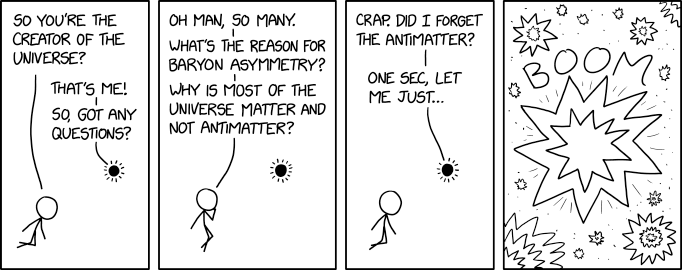
Baryon Asymmetry

XKCD · view →
Wait, what do you mean,

Wait, what do you mean,